
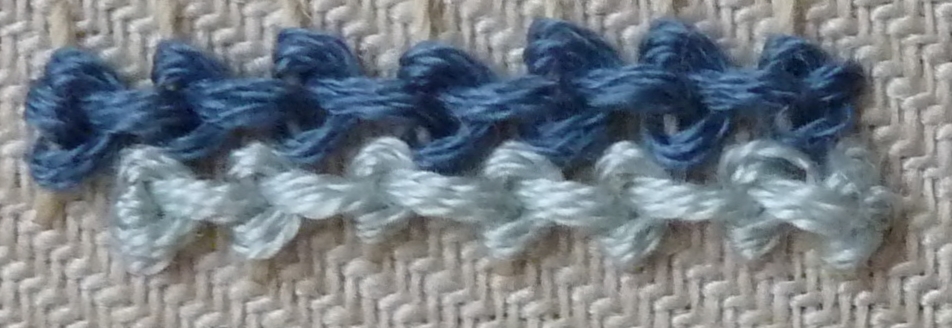
For the last two weeks I've been learning canvaswork (at the RSN, of which I'm sure I'll post more in the future, but I will try to limit mentions of how amazing it is to study in a palace).
I've learnt loads already, both technically but also about what constitutes canvaswork: cross stitch, Bargello, and what I would have called tapestry (amongst other names/styles). Apparently tapestry is a misnomer which stems from the 17th century when canvaswork hangings were made in imitation of the expensive tapestries which adorned palaces and country estates - they were meant to look like tapestries and the name persists, particularly in the expensive kits sold in stately home gift shops.
This is my first finished piece - it's tiny as it's a birthday card, the stitched section measures just 5cm square. The stitches are Jessica stitch (they are the stitches which look sort of like polo mints around the Shisha mirrors), French knots (both within and between the polo mints) and in the very centre, velvet stitch (also known as plush work). Velvet stitch is the most tactile stitch I've ever come across - even done in stranded cotton, it feels super soft and luxurious, and reminds me of making pompoms at home as a kid. Only now I get to make them in a palace ...

 I'm trying to convince myself that I like the new technique we started learning last week: silk shading. It's so tiny, ridiculously small, which means it takes forever, and then the finished piece is just ... flat.
 Plants were often used not just for their aesthetic appeal, but as metaphors for all elements of life. In keeping with the more bawdy portrayals of Elizabethan society, peapods were reknown for their phallic symbolism. I can almost hear the Blackadder theme music striking up.
  Spent yesterday at a print-making workshop. Covered mono-printing, dry-point etching, lino print and the theory of woodcutting. I much preferred mono-printing and lino (dry-point etching is like someone dragging their fingernails down a blackboard, and woodcutting seemed like way more effort than lino). And top tip for lino cutting - heat the lino with a hairdryer or on a radiator for five minutes.


 For the last two weeks I've been learning canvaswork (at the RSN, of which I'm sure I'll post more in the future, but I will try to limit mentions of how amazing it is to study in a palace).
